
Criminal Cases in the Benton County Courts
The Iowa District Court in Benton County hears felony, misdemeanor, and related criminal matters as part of Judicial District 6. Magistrate functions at the same courthouse include initial appearances, simple misdemeanors, and assigned proceedings. Iowa has no city municipal criminal court. State-law and county-ordinance prosecutions therefore move through the unified District Court system, while a city attorney handles city ordinance matters.
The Clerk of Court keeps the judicial case file. That file is centered on what was charged in court, not the full police investigation. It grows as the complaint, appearance, plea, motions, rulings, disposition, sentence, and financial entries reach the docket. A sheriff incident number and a court case number label different records. Match them through the person, event date, arresting agency, and any case number shown on the booking sheet.
Benton County Criminal Case Clerk
The official Benton County court directory lists the Clerk of Court at 111 E. 4th Street, Vinton, IA 52349, 319-472-2766. The general courthouse schedule is Monday through Friday, 8:00 a.m. to 4:30 p.m., except holidays. Call about older or archived Benton County criminal cases, document images that do not appear online, certified copies, and two people with similar names. Public terminals or clerk services can supply access that a basic web result cannot.
The Iowa Judicial Branch also provides a case-payment lookup tied to court case information and financial obligations.

The payment interface is one court access route, though the docket and clerk remain the sources for charge history and final case status.
How to Search Case Records
Iowa Courts Online is the main public index for a Benton County criminal case search. A name search can find candidates, while an exact date of birth or full case identifier reduces mistaken matches. Read beyond the first result. Status, charges, events, and disposition must refer to the same case and person.
- Open Iowa Courts Online and choose the name, date-of-birth, case-ID, or citation search that fits the facts already known.
- Enter the name carefully. Use Benton County and the case type when the case-ID mode asks for them.
- Compare the filing date, case type, party details, and charge entries before treating a result as a match.
- Open the docket and follow events through the plea or trial result, judgment, sentence, and later enforcement entries.
- Call or visit the Benton County Clerk for public documents, certification, an archive question, or an online image that is unavailable.
| Field Label | Type | Required | Notes |
|---|---|---|---|
| Name Search | Tab | Mode based | Last or firm name needs at least two letters; first and last support the % wildcard. |
| Date of Birth Search | Tab | Exact DOB and first/last names | First and last names do not take wildcards in this mode. |
| Case ID Search | Tab | County and case type | A full ID has 17 characters; letters must be capitals. |
| Citation Number | Text | Yes in citation mode | Use the number printed on the citation. |
| Middle Name | Text | No | A wildcard in DOB mode also matches a blank middle-name field. |
The Judicial Branch's Iowa Courts Online help document explains wildcards, search modes, and the case-ID format. A broad wildcard can produce several candidates. Narrow the search with an exact birth date or known case identifier, then use the clerk when the public index lacks enough detail to make a sound match.
Benton County Criminal Court Calendar
The local court schedule gives context to docket entries. District Court trials generally begin Monday. Juvenile matters are usually Tuesday. Magistrate initial appearances, pretrials, and trials tend to fall Wednesday. District Court arraignments, pleas, sentencings, pretrials, and probation revocations are generally set Thursday. Friday is mainly civil, with criminal matters at times.
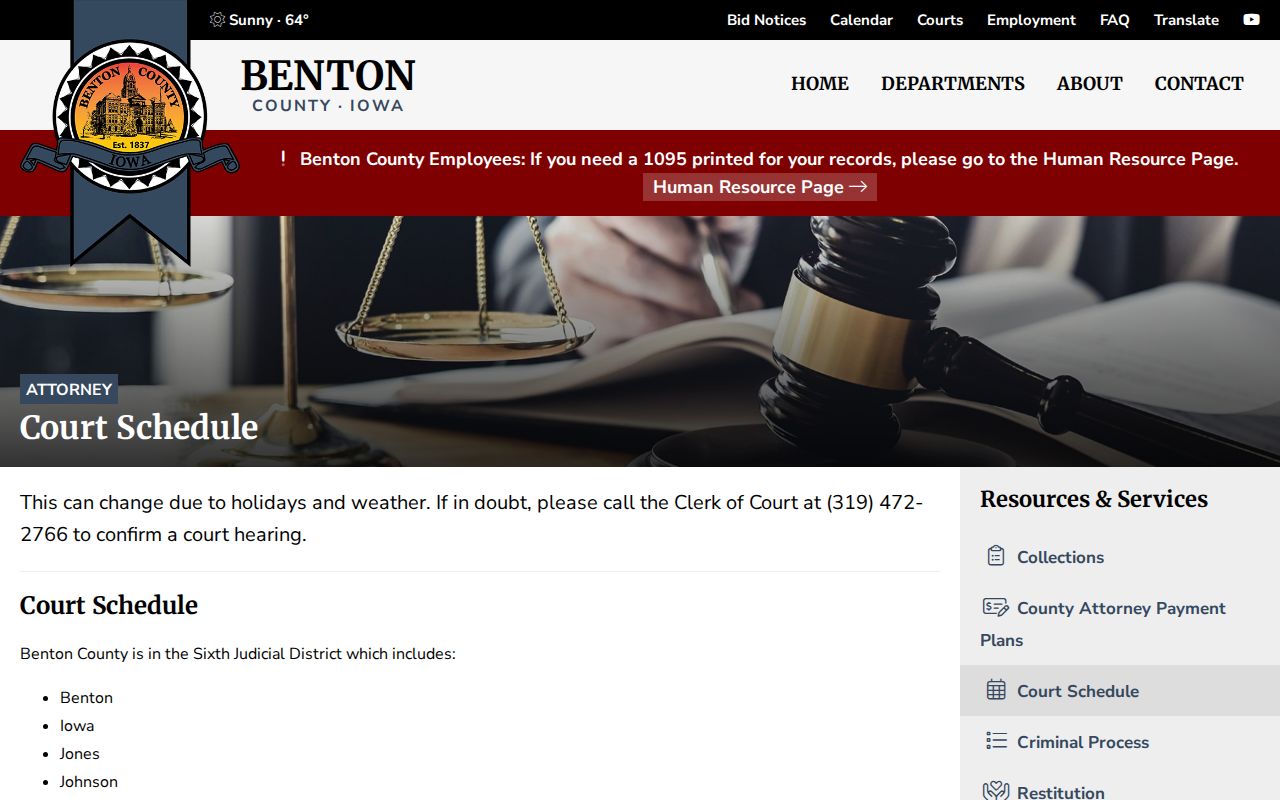
The calendar is a pattern, not a promise. Holidays, weather, and court orders can change a setting, so confirm a hearing with the clerk before relying on the weekday pattern.
What the Case File Shows
A Benton County court file is case-centered. It identifies the court and parties, states the formal filed counts, and records each public step toward an outcome. It may also show financial obligations and later probation or warrant events. Public document access varies. Protected filings and personal data may be restricted or redacted, and an EDMS account or courthouse terminal may be needed for some images.
| Case Number & Court | Iowa case identifier, Benton County, court, case type, status, and filing date. |
|---|---|
| Charging Document | Filed count, description, Iowa Code section, offense class, and amendment status. |
| Docket Entries | Chronological public events such as appearances, motions, pleas, trial settings, judgment, and later enforcement. |
| Parties & Counsel | State of Iowa, defendant display name, and attorneys when public. |
| Disposition & Judgment | Plea or verdict, dismissal, acquittal, deferred result, and judgment entries as applicable. |
| Sentence & Financials | Jail or prison term, suspended time, probation, fines, costs, surcharges, restitution, and balances where public. |
Read charge rows and disposition rows together. A filed count may be amended or dismissed, while another count reaches judgment, so the case header alone does not state the full outcome.
Benton County Criminal Case Numbers
A common search error is to type a sheriff incident number into the court case field. Iowa Courts Online describes a full court case ID as 17 characters and requires capital letters, with county and case type selected in case-ID mode. An arrest report number belongs to the agency investigation. A booking number belongs to the jail intake. Neither is automatically the District Court identifier.
If the number is incomplete, search by name and exact date of birth, then compare filing date, offense, and attorney entries. The clerk can help identify the proper public file when the online candidates remain unclear. A name match alone is too weak, especially when the record lacks enough detail to distinguish two people.
Note: Keep each identifier beside its source so a Benton court case, sheriff report, and jail booking do not blur together.
Stages of a Criminal Case
An investigation may lead to an arrest or complaint, but the County Attorney decides what state-law charge to file. The accused then appears in court, receives the filed accusation, and enters a plea. Pretrial orders and motions shape what happens next. A plea agreement requires court acceptance; otherwise the matter may proceed to trial. The result can be conviction, acquittal, dismissal, or another authorized disposition. Sentencing follows a conviction under the offense law and applicable Iowa misdemeanor sentencing provisions, and later probation, revocation, warrant, financial, or appeal entries may extend the docket.
Case flow: Charges Filed › Arraignment › Pretrial › Plea or Trial › Disposition › Sentencing
The arresting agency's first charge may differ from the filed count. For that reason, the judicial file controls the formal prosecution record, while the incident report preserves what the agency recorded at the start.
Benton County Criminal Charge Filing
The Benton County Attorney reviews and prosecutes state-law offenses, county ordinance violations, juvenile delinquency, and related statutory matters. City ordinance cases go to a city attorney. The prosecutor's decision explains why a booking charge can change, why some arrests do not become court cases, and why the filed information or count is more useful than an early jail label when reading the prosecution.
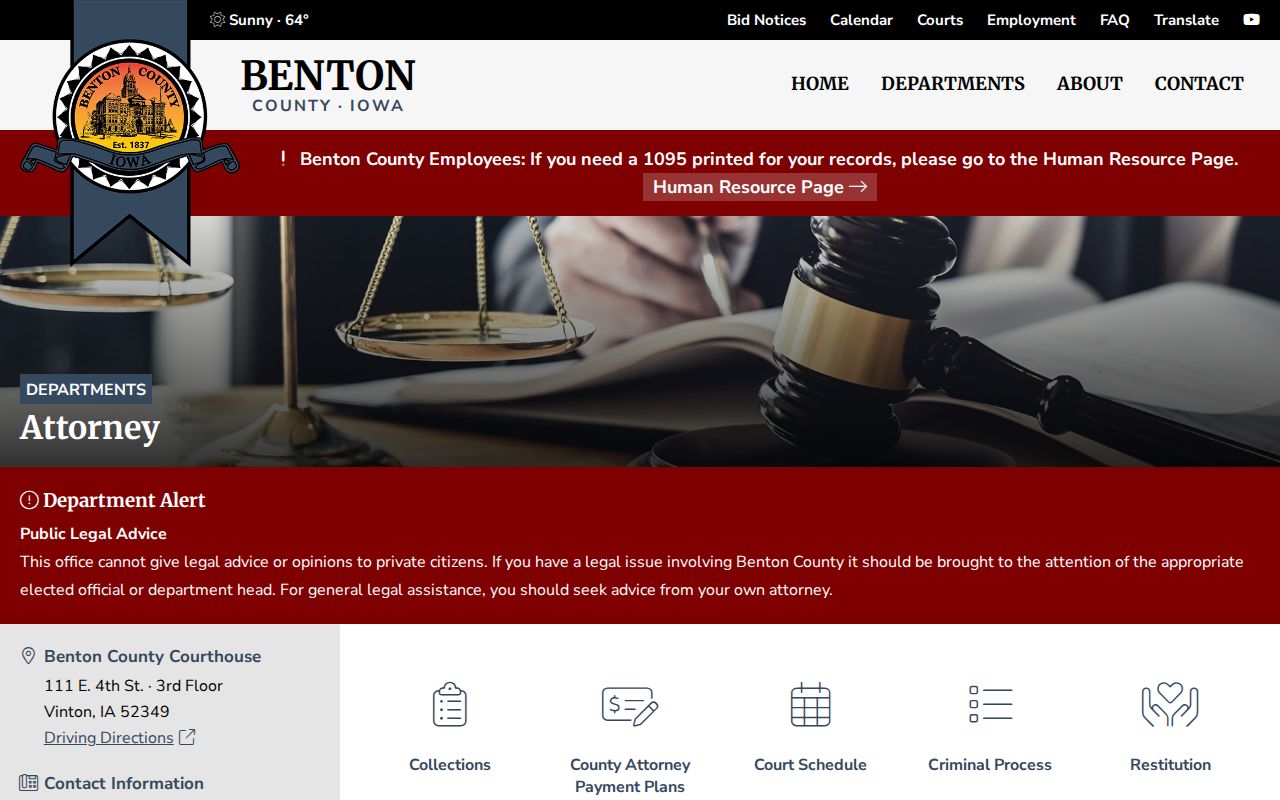
The office is on the courthouse third floor at 111 E. 4th Street. Its court line is 319-472-2436, and weekday public hours are 8:00 a.m. to noon and 1:00 to 4:30 p.m. The office cannot give private citizens legal advice. A person seeking appointed counsel asks the court under the State Public Defender process, with the Cedar Rapids public defender office serving the regional system.
Benton County Criminal Case Outcomes
Disposition means the result of a charge or case. A conviction follows a guilty plea or verdict. An acquittal is a not-guilty trial result. A dismissal ends the charge without conviction, though the legal effect and any chance of refiling depend on the case. An Iowa deferred judgment postpones judgment while conditions are completed. Successful discharge is a non-conviction, but court expungement and DCI treatment are not identical.
- Dismissal
- A charge ends without a conviction; read the docket for the exact order and timing.
- Acquittal
- A trial ends in a not-guilty finding.
- Deferred judgment
- Judgment is held back while the person completes court conditions.
- Sentence
- The court-ordered result after conviction, which may include custody, probation, and financial terms.
Chapter 901C provides outcome-specific expungement paths, and the Iowa Judicial Branch expungement materials supply the official forms and instructions. After an order, check both the court display and a DCI self-review because a discharged deferred judgment can remain in DCI data with restricted release rules.
Access & Restrictions
Iowa Code chapter 22 supports examination and copying of public records unless another law makes the material confidential. Court access also follows Iowa court rules, EDMS controls, redaction rules, and orders in the case. Juvenile matters are generally confidential. Protected victim or minor data, personal identifiers, and sealed filings do not become public merely because the rest of a docket can be searched.
An absent image does not prove an absent case. Ask the Benton County Clerk whether a public document requires an account, courthouse access, a copy request, or archive retrieval. Appeals and related record provisions also appear in Iowa Code chapter 814. Conversely, a docket entry is not the full police narrative and not an Iowa DCI rap sheet. For a wider explanation of how those systems differ, use the Benton County criminal history overview.